Pi agent runtime
Pi provides the runtime surface: package loading, shell interaction, user workflow, and the place where cyb3r can operate. Think of it as the operating-system layer of the stack.

cyb3r
offensive AI operator stack
cyb3r is the system I am building around Pi: an agent runtime, an operator harness, a dedicated reasoning model, and pi-pen-kit tooling that lets AI workflows use real pentesting capabilities without losing operator control.
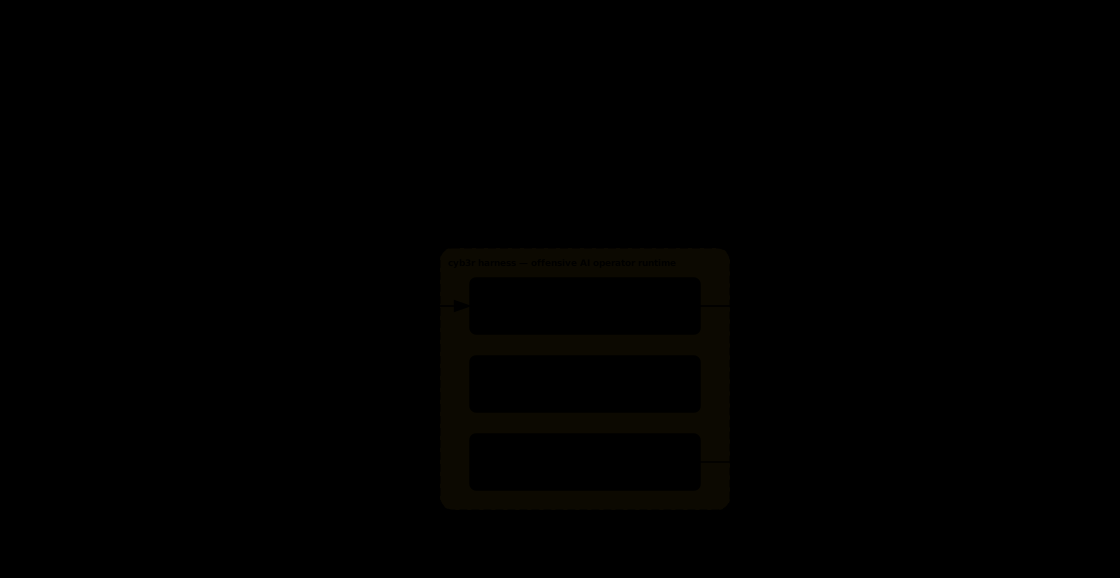
system model
I think about cyb3r less as “a model” and more as an operator system. The model matters, but it only becomes useful when it can drive tools, preserve context, and reason like an operator.
Pi provides the runtime surface: package loading, shell interaction, user workflow, and the place where cyb3r can operate. Think of it as the operating-system layer of the stack.
cyb3r is the operator harness built on top of that runtime. It coordinates reasoning, plans, tool use, evidence handling, and the loop between actions and reassessment.
The fine-tuned model provides dedicated penetration-testing reasoning, branch ranking, pivot decisions, rabbit-hole avoidance, and controlled tool-call behavior. Think of it as the CPU of the harness.
pi-pen-kit exposes real offensive tooling to the harness: controlled reverse shells, Sliver, Metasploit, listener/session management, and operator-level C2 workflows.
pi-pen-kit
pi-pen-kit is the bridge between cyb3r and the tools an operator actually uses. It is not just a list of command wrappers. It keeps interactive state alive so the agent can continue working across tool calls.
A normal `nc -lvnp 4444` listener is awkward for an agent because the session belongs to the shell process that started it. pi-netcat replaces that with a controlled shim and daemon: the listener owns sockets, the agent can list sessions, read buffered output, write commands, interrupt stuck processes, probe responsiveness, and close sessions.
That turns a fragile interactive reverse shell into a tool-controlled workflow that the harness can reason about.
model
The current training target is a Qwen-class 27B model with a reasoning-first cybersecurity fine-tune. The first training pass spans epochs 01-03 and is running now. The initial focus is behavior: planning, reassessment, branch ranking, and tool-use discipline. Security knowledge expansion comes after the reasoning pass. In the stack, the model is best understood as the CPU that drives operator judgment inside the harness.
Training hardware is currently the limiting factor. I am actively looking for partners who can help with compute, evaluation, applied security feedback, or controlled real-world workflows.
Hugging Face model card