Research workspace
AXIOM gives one place to upload sources, chat with documents, start research missions, inspect notes, and turn evidence into structured drafts.
AXIOM
self-hosted AI research system
AXIOM is the tool I built for document-heavy research. It ingests PDFs and web sources, builds a searchable evidence layer, runs agentic research missions, and helps turn the gathered material into structured papers and drafts with visible citations.
system
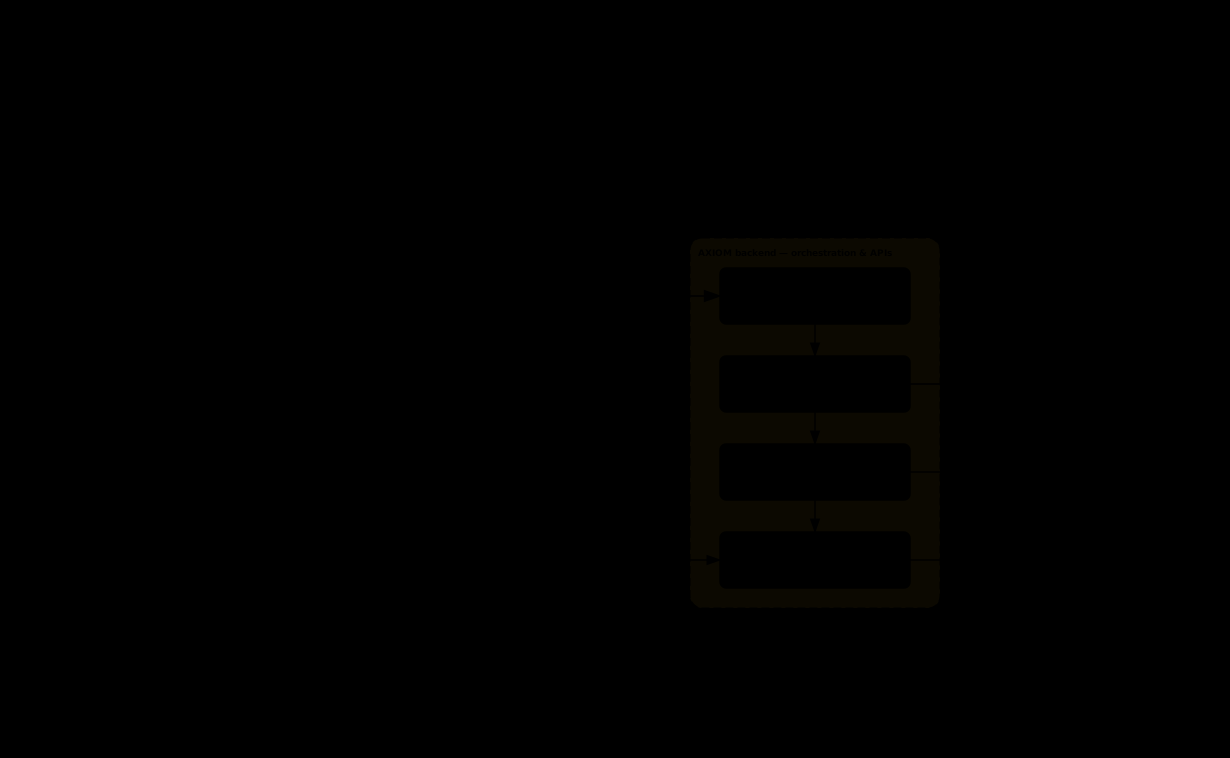
AXIOM is not just a chat interface over a vector database. It combines a document pipeline, a retrieval layer, model routing, research agents, writing workflows, and self-hosted deployment boundaries so the research process remains inspectable.
AXIOM gives one place to upload sources, chat with documents, start research missions, inspect notes, and turn evidence into structured drafts.
The backend owns missions, API calls, WebSocket updates, queues, document state, report artifacts, and the controller that coordinates the agent workflow.
LLM calls are routed through role-based model slots: fast, mid, intelligent, and verifier. Providers can be hosted or local as long as they expose an OpenAI-compatible API.
Documents become chunks with metadata, page labels, dense and sparse embeddings, BM25 search records, entities, relationships, and image embeddings.
A background processor converts PDFs, Word files, Markdown, and web material into searchable evidence with metadata enrichment and citation-ready page context.
Embedding, reranking, and entity extraction are GPU-accelerated through an isolated worker, with device placement tuned for constrained local GPUs. Heavy PDF and relation models run in short-lived subprocesses so VRAM can be released cleanly.
model stack
AXIOM separates reasoning models from retrieval models. LLM providers are used through role slots, while local ML models handle embeddings, reranking, entity extraction, relation extraction, image search, and PDF conversion.
Used for lower-latency work such as planning support, note assignment, query strategy, metadata extraction, and small structured decisions.
Used for core research and writing tasks where AXIOM needs stronger synthesis without spending the most capable model on every step.
Used for reflection, query preparation, deeper reasoning, and quality-sensitive parts of the mission loop.
Used for focused validation and checks where deterministic judgment matters more than broad generation.

Dense and sparse text embeddings for document chunks and queries.
Cross-encoder reranking after vector, BM25, and graph candidates are merged.
Zero-shot entity extraction for people, organizations, locations, concepts, works, and methods.
Multilingual relation extraction for knowledge-graph triples.
Image embeddings for figures and extracted PDF images.
PDF-to-Markdown conversion with page markers, tables, formulas, and optional LLM-enhanced OCR.
evidence pipeline
A research mission can use local documents, web search, fetched web pages, and arXiv imports. The output stays tied to the evidence layer: notes, page numbers, source metadata, citation style, and draft versions remain visible instead of disappearing into a single model response.

research agents
AXIOM decomposes a research question into work that can be inspected: initial questions, searches, relevant notes, reflection output, outline changes, note assignments, writing passes, and report versions.
The agents are supported by tools rather than free-form prompting alone: document search, web search, page fetching, arXiv ingestion, file reading, calculator calls, structured document access, writing tools, and reference integration.